Your VO₂ Max Is Strong, but You Still Fatigue Early: What Else Should Be Evaluated?
Nov 11, 2026
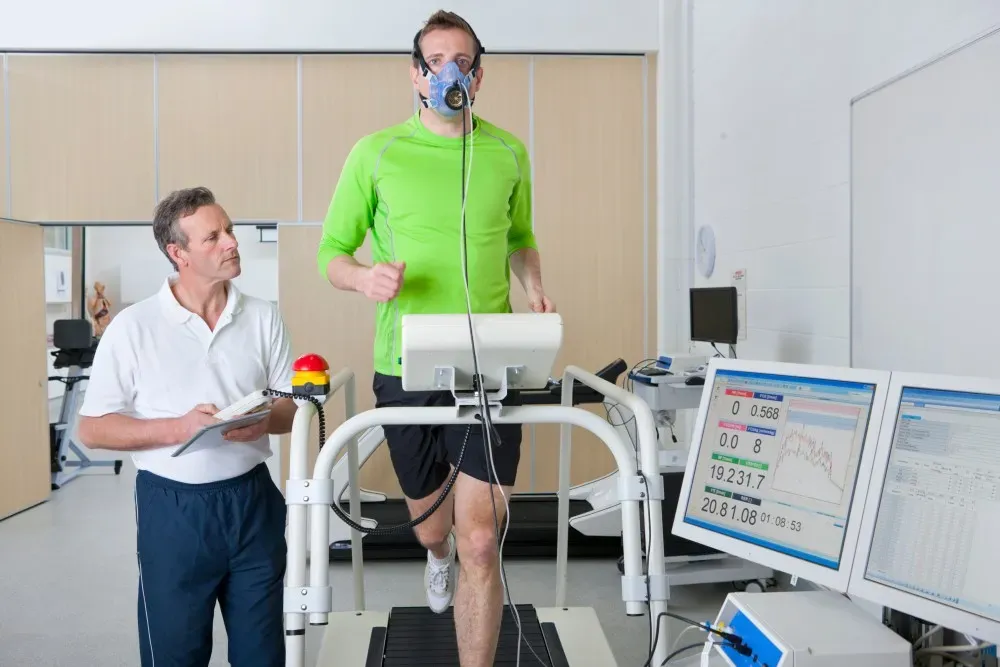
VO₂ max is one of the most recognized measures of aerobic fitness.
It represents the maximum rate at which the body can take in, transport, and use oxygen during intense exercise. Higher values generally indicate greater aerobic capacity.
But there is a common misconception:
A high VO₂ max should mean you can exercise for a long time without becoming fatigued.
Not necessarily.
Two people can have similar VO₂ max values and very different exercise experiences.
One may comfortably sustain a demanding pace for a long period. The other may fatigue relatively early despite having a strong maximal aerobic capacity.
Why?
Because endurance performance depends on much more than the maximum amount of oxygen the body can use.
Think of VO₂ max as an individual's aerobic ceiling.
It tells us about maximum capacity.
But most daily activities and endurance exercise occur below that ceiling.
What happens at those lower intensities can be equally important.
Exercise physiologists therefore also examine measures such as:
Ventilatory threshold
Lactate threshold
Heart-rate response
Oxygen-uptake kinetics
Ventilatory efficiency
Exercise economy
Muscular endurance
Research and clinical reviews of cardiopulmonary exercise testing increasingly emphasize that submaximal responses can provide information that peak VO₂ alone may miss.
This is particularly relevant when someone reports significant fatigue despite apparently good aerobic capacity.
One of the most useful questions is not simply:
"How high is your VO₂ max?"
but:
"At what intensity does exercise start becoming substantially harder to sustain?"
The ventilatory threshold represents a point during increasing exercise intensity where breathing begins to increase disproportionately relative to oxygen consumption.
It is related to the body's increasing reliance on metabolic pathways associated with higher-intensity exercise.
Two people can have similar VO₂ max values but reach this threshold at very different workloads.
Person A
VO₂ max: High
Threshold: Relatively high percentage of VO₂ max
Can sustain a strong pace efficiently
Person B
VO₂ max: High
Threshold: Lower percentage of VO₂ max
Reaches uncomfortable intensity sooner
Their maximum aerobic capacity may look similar.
Their endurance experience may not.
Lactate is produced during normal metabolism and is not simply a "waste product" responsible for fatigue.
At increasing exercise intensities, lactate production and clearance change.
The lactate threshold is one way of identifying an intensity at which lactate begins to accumulate more rapidly.
It can provide useful information about sustainable exercise intensity.
Recent research continues to examine the relationship between lactate thresholds, gas-exchange thresholds, and other metabolic markers, reinforcing that these measures are related but not interchangeable.
For someone who fatigues early, understanding where these thresholds occur can reveal information that a single VO₂ max number cannot.
Heart rate provides another important piece of the picture.
During exercise, the cardiovascular system must increase cardiac output to deliver oxygen to working muscles.
A useful evaluation can consider:
Resting heart rate
Exercise heart rate
Heart-rate response to increasing workload
Recovery heart rate
Whether the expected heart-rate response occurs
A strong VO₂ max with an unusual heart-rate response may warrant a closer look, particularly when accompanied by symptoms.
However, heart-rate data should always be interpreted in context because medications, hydration, temperature, fitness level, age, and other factors can influence it.
Someone may have a good VO₂ max but still become unusually short of breath during exercise.
That raises a different question:
How efficiently is the respiratory system handling the workload?
Cardiopulmonary exercise testing can evaluate variables beyond VO₂ max, including ventilation relative to carbon dioxide production and other measures of breathing efficiency.
These measurements can help clinicians distinguish among different potential contributors to exercise limitation.
A 2025 review describes CPET as a useful tool for identifying the primary cause of exercise limitation when routine evaluation is inconclusive or when multiple factors may be contributing.
A high VO₂ max does not automatically mean your muscles can sustain the workload efficiently.
Exercise performance also depends on:
Muscle strength
Local muscular endurance
Neuromuscular coordination
Mitochondrial function
Oxygen extraction
Movement efficiency
The cardiovascular system may deliver plenty of oxygen while the working muscles still become fatigued.
Exercise physiology describes VO₂ as the interaction between oxygen delivery and peripheral oxygen utilization. In simplified terms, getting oxygen to the muscle and using that oxygen effectively are related but distinct parts of the process.
Imagine two people cycling at the same speed.
Both have excellent cardiovascular capacity.
But one person uses more energy to produce the same external workload because their movement is less efficient.
That additional energy demand can contribute to earlier fatigue.
Movement efficiency can be influenced by:
Technique
Strength
Coordination
Joint mobility
Stability
Previous injuries
Training experience
This is particularly relevant for runners, cyclists, and active adults who may have good cardiovascular fitness but still struggle with sustained activity.
Aerobic fitness does not eliminate the need for muscular strength.
Consider climbing a steep hill.
Your cardiovascular system may be capable of supplying enough oxygen, but if the muscles involved in the movement lack sufficient strength or endurance, the activity can still feel disproportionately difficult.
Strength can influence:
Force production
Running and walking economy
Postural control
Movement efficiency
Fatigue resistance
This is why a comprehensive assessment should not stop at cardiovascular testing.
Fatigue during exercise is not always caused by inadequate fitness.
Recovery between sessions matters.
A person who consistently trains hard while sleeping poorly may experience fatigue even if their aerobic fitness is excellent.
Relevant factors include:
Sleep duration and quality
Training volume
Training intensity
Nutrition
Hydration
Psychological stress
Recovery time
This creates an important distinction:
Fitness tells you what the body can do. Recovery influences what it can repeatedly do.
Exercise requires energy.
If carbohydrate availability is inadequate before prolonged or intense exercise, fatigue may occur even when cardiovascular capacity is excellent.
Nutrition also influences recovery and adaptation.
For active adults, evaluation may therefore need to consider:
Overall energy intake
Carbohydrate availability
Protein intake
Hydration
Electrolyte losses
Timing of meals around exercise
A strong VO₂ max cannot compensate for consistently inadequate fueling.
Sleep affects more than how rested you feel.
It is involved in:
Neurological recovery
Hormonal regulation
Tissue repair
Cognitive function
Exercise readiness
Someone who has excellent cardiovascular fitness but consistently poor sleep may experience more fatigue during training.
If fatigue seems disproportionate to the workload, sleep quality deserves consideration alongside fitness measurements.
Persistent fatigue should not automatically be interpreted as a training problem.
Medical contributors can include conditions affecting:
Hemoglobin and oxygen transport
Thyroid function
Glucose regulation
Iron status
Cardiovascular function
Pulmonary function
This does not mean every person who fatigues during exercise needs extensive medical testing.
It means persistent, unexplained, or disproportionate fatigue deserves appropriate evaluation rather than simply increasing training volume.
Instead of asking only:
"What is my VO₂ max?"
consider evaluating multiple dimensions.
VO₂ max or VO₂ peak
Heart-rate response
Heart-rate recovery
Exercise workload
Ventilatory threshold
Lactate threshold when appropriate
Exercise intensity domains
Strength
Local muscular endurance
Power
Fatigue resistance
Mobility
Balance
Coordination
Movement efficiency
Sleep
Training load
Nutrition
Hydration
Stress
This creates a much more useful picture of physical capacity.
Maximum testing answers one question:
How much can you produce at your peak?
Submaximal testing can answer another:
How efficiently can you sustain a given workload?
That distinction is increasingly important in exercise physiology.
Recent literature on cardiopulmonary exercise testing highlights measures such as ventilatory threshold, oxygen-uptake kinetics, ventilatory efficiency, and oxygen-pulse responses as potentially valuable complements to peak VO₂ in understanding exercise limitation.
For someone who says, "My fitness looks good on paper, but I fatigue much earlier than I should," these additional measurements may be more revealing than simply repeating a VO₂ max test.
Exercise fatigue is not automatically a sign of illness.
However, medical evaluation becomes more important when fatigue is:
New or unexplained
Disproportionate to the activity
Progressively worsening
Associated with unusual shortness of breath
Associated with chest discomfort
Associated with dizziness or fainting
Associated with palpitations
Affecting normal daily activities
Current sports-cardiology guidance emphasizes evaluation of athletes who develop exertional chest pain, disproportionate breathlessness, dizziness, palpitations, or syncope.
These symptoms should not simply be managed by adding more recovery treatments or changing a workout program.
VO₂ max is an excellent metric.
But it is one metric.
Improving aerobic capacity can be valuable, but a well-rounded approach also asks:
Can you sustain exercise efficiently?
Can your muscles tolerate the workload?
Can you recover between sessions?
Can you maintain good movement quality?
Is your heart responding appropriately?
Is your breathing efficient?
Are you adequately fueled and rested?
A high VO₂ max paired with poor movement efficiency or inadequate recovery may not produce the performance someone expects.
VO₂ max measures maximal aerobic capacity, but it does not fully describe endurance or exercise tolerance.
Ventilatory and lactate thresholds can provide information about how much of that capacity can be sustained.
Heart-rate response, breathing efficiency, muscular strength, movement economy, and recovery can all influence fatigue.
Nutrition, hydration, and sleep can affect exercise performance even when cardiovascular fitness is excellent.
Persistent or disproportionate fatigue may warrant appropriate medical evaluation.
A broader assessment can provide more actionable information than relying on a single fitness number.
A strong VO₂ max tells you that the body has substantial aerobic capacity.
It does not tell you exactly where fatigue begins.
For someone who becomes tired earlier than expected, the next step is not necessarily to train harder. It may be to understand whether the limiting factor is metabolic threshold, muscular endurance, movement efficiency, recovery, breathing, cardiovascular response, or something outside normal training physiology.
That is the value of looking beyond the headline number.
VO₂ max tells part of the story. A comprehensive assessment can help explain the rest.